Jumble Solver Instant Letter Unscramble Help | 100% Free Online | 2026
Enter your scrambled letters and get accurate word results in seconds. Fast, free, and easy to use.
Wanna try the opposite of jumble? Check out our Jumble These Letters Scrambler
Instant Results
Get answers in seconds without delay
No Data Stored
Your inputs are never saved or tracked
Mobile Friendly
Works perfectly on all devices
Smart Algorithm
Finds the best possible words instantly
Have you ever stared at a bunch of scrambled letters and felt your brain just give up on you? You keep rearranging them, trying every possible combo, convincing yourself the answer is right there, but nothing clicks. Then you open some random jumble helper and it throws a massive messy list of words at you like it is guessing blindly. That only makes things worse and wastes even more time.
That is exactly why we built our Jumble Solver. Instead of dumping random dictionary words, our tool actually understands your letters, your wildcards, and your word length. It filters results properly so you are not digging through nonsense. Whether you are solving today’s newspaper jumble, stuck on homework, or trying to win a word game without frying your brain, the jumble online solver keeps things simple and accurate.
So instead of running in circles, get straight to the point. Enter your letters, tap solve, and watch those scrambled pieces fall into place like a puzzle finally clicking together. Try our Jumble Solver now and turn letter chaos into clear answers in seconds!
Jumble Answers For Today
If today’s jumble is twisting your brain into knots and those scrambled letters just refuse to line up, you can skip the guesswork and check the correct answers instantly right here. Simply click on any jumbled word to reveal the clean solution without digging through messy word lists or second-guessing every combination, and if you want an even quicker hit with zero brain strain, jump straight to our full answer guide on the site and unlock every solution in seconds.
What’s New?
What Is The Jumble Solver?
Jumble Solver is basically your brain’s backup plan when scrambled letters start looking like alphabet soup. Instead of staring at a messy pile of characters and hoping something magically clicks, this tool takes your mixed-up letters and rearranges them into real, valid words in seconds. Think of it like a smart word engine that sifts through combinations faster than you ever could, matching patterns, filtering by length, and handling wildcards without breaking a sweat.
At its core, a jumble solver generates all possible letter permutations and checks them against a built-in dictionary database. But a good solver does more than just dump random words. It sorts results by length, prioritizes meaningful matches, and lets you narrow things down when you are chasing a specific word size or puzzle type.
Whether you are solving the Daily Jumble, working through homework, playing Scrabble, or competing in Words with Friends, the jumble solver acts like a Swiss Army knife for word games. You can also use wildcards such as ? or * when a letter is unknown. That means even if your puzzle feels incomplete, the solver can still connect the dots and show realistic word options. It turns guesswork into strategy and confusion into clarity.
Quick Example
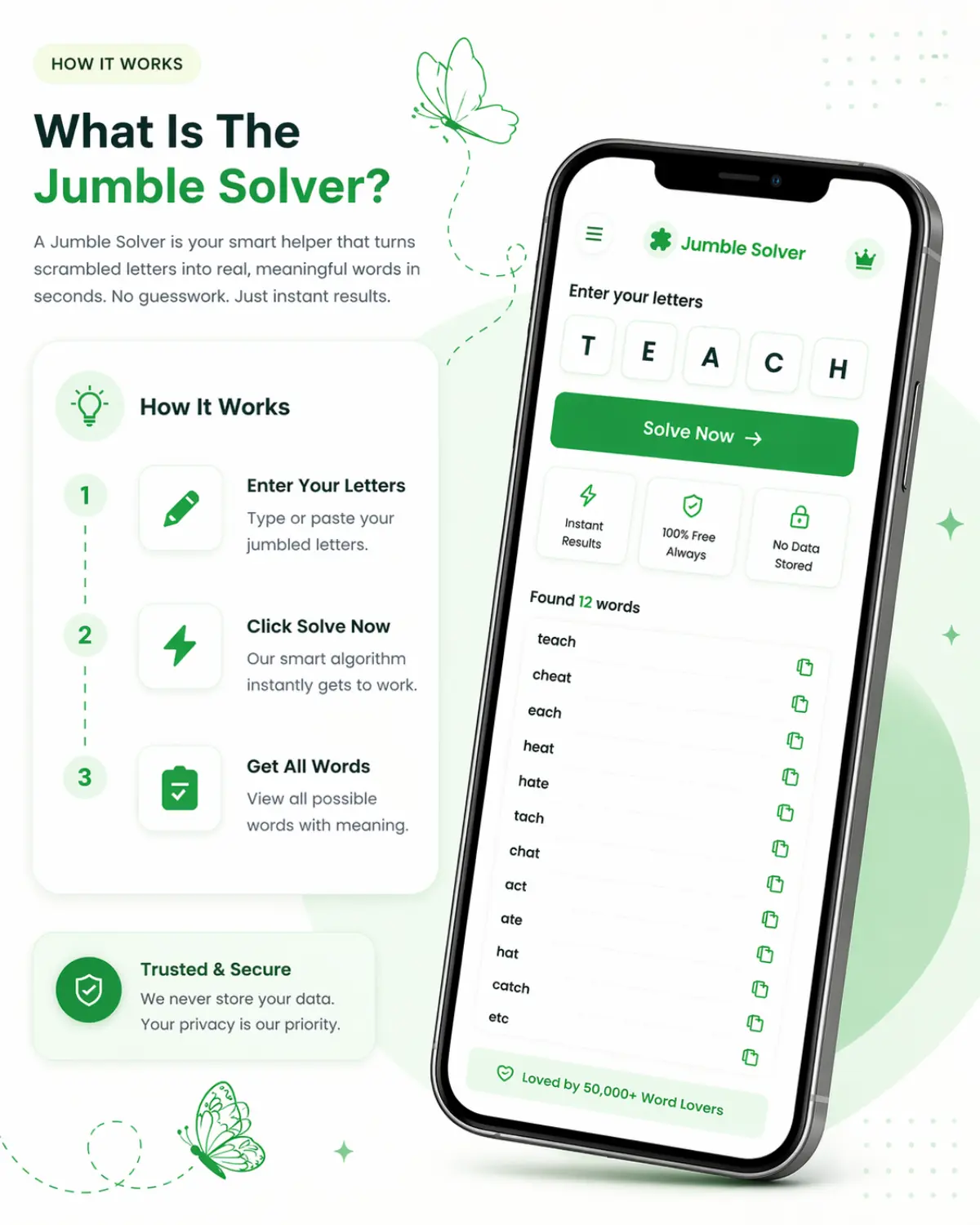
Let’s say you are stuck with the letters T, E, A, C, H. You shuffle them around and nothing solid forms at first. Instead of wasting time, you enter them into the jumble solver and hit search. Instantly, you get organized results like:
Now the answer jumps out at you instead of hiding in plain sight. That is how a proper word jumble solver works. It takes scattered letters and lines them up into clear possibilities without making you chase every combination yourself.
So instead of letting scrambled letters tie your brain in knots, use a solver that actually works. Enter your letters, tap solve, and watch those jumbled pieces fall into place like a puzzle finally snapping together.
Who Uses Jumble Helpers?
A jumble solver is not just for one type of player. From casual puzzlers to competitive word nerds, a jumble helper fits anywhere scrambled letters show up and refuse to behave.
Students & Homework Warriors
When classroom worksheets turn into letter chaos, students often reach for a word scramble solver to save time and sanity. Instead of guessing blindly and second-guessing every combination, they use a jumble cheat to quickly see valid word options. It keeps assignments moving and frustration levels low.
Daily Jumble Fans
Newspaper puzzle lovers know the feeling. Three words fall into place, and then one stubborn scramble blocks everything like a traffic jam. That is when a jumble solver becomes the rescue tool. It clears the mental fog and helps them finish the full puzzle without staring at the page for hours.
Competitive Word Game Players
Scrabble grinders, Words with Friends players, and anagram enthusiasts treat a word scramble solver like a tactical advantage. It helps them uncover high-value words, test combinations fast, and sharpen their pattern recognition. Under time pressure, a jumble cheat can feel like a strategy booster rather than just a shortcut.
Casual Puzzle Solvers
Not everyone is chasing trophies. Some people just want to enjoy a quick brain game during lunch or while commuting. When letters refuse to cooperate, the jumble solver keeps the vibe relaxed. Instead of getting stuck and quitting, they solve the word and keep the flow going.
Content Creators & Brain Teaser Makers
Even puzzle creators use a jumble solver to verify answers and test difficulty levels. It helps ensure that scrambled words actually have valid solutions and no hidden surprises.
At the end of the day, anyone who deals with mixed-up letters can benefit from a solid jumble solver. Whether you are studying, competing, or just chilling with a daily puzzle, a word scramble solver turns scrambled chaos into clean, readable words in seconds.
How Does The Jumble Word Finder Work?
At first glance, a jumble word finder looks simple. You type in scrambled letters, hit solve, and boom, you get answers. But under the hood, there is real word-engine logic running like a silent machine, sorting chaos into clean vocabulary. Here is what actually happens behind the scenes:
Dictionary Database
Every solid jumble solver is powered by a structured dictionary database. Think of it as a massive word vault containing thousands of valid English words. When you enter your scrambled letters, the system does not guess randomly. It checks combinations against this verified word list to make sure every result is real and playable.
That means no fake words, no weird nonsense strings, and no wasted clicks. Only legit matches that actually exist in standard word game dictionaries.
Letter Permutation Logic
This is where the magic kicks in. The jumble solver uses permutation algorithms, which is just a fancy way of saying it rearranges your letters into every possible order at lightning speed. If you enter six letters, it generates all viable combinations mathematically, way faster than a human brain could shuffle them.
Instead of manually testing patterns in your head like you are solving a Rubik’s Cube blindfolded, the jumble solver does the heavy lifting in milliseconds.
Wildcard Handling
Stuck with a missing letter? That is where wildcard logic steps in. If you enter a ? or * in place of an unknown letter, the system treats it as a flexible slot. It temporarily substitutes every possible alphabet letter in that position and tests each variation against the dictionary database.
So even if your puzzle feels incomplete, the word scramble solver still finds valid answers. It fills in the blanks without breaking stride.
Sorting by Length and Score
Once all valid words are generated, the jumble solver tool organizes them intelligently. Results are typically sorted by word length, from longest to shortest, so you can quickly spot high-impact answers. Some advanced jumble cheat tools even prioritize words based on potential game score, especially for Scrabble-style formats.
Instead of dumping a messy wall of text, the solver structures the output cleanly. Short words, long words, strategic words, all laid out like a neat word buffet. So when you type your scrambled letters and click search, you are not just getting random guesses. You are triggering a combination engine backed by dictionary validation, permutation math, wildcard expansion, and structured sorting logic.
When You Might Need It?
There are moments when scrambled letters feel less like a fun challenge and more like a mental traffic jam. That is when a jumble solver quietly steps in like a calm problem-solver, cutting through the chaos and lining everything up neatly. Whether you are under pressure or just having a brain freeze, this tool keeps things smooth instead of stressful.
Homework Struggles
Stuck on homework and the scrambled word refuses to click no matter how many times you reshuffle it.
Daily Jumble Block
Solving a daily newspaper puzzle and one stubborn jumble blocks the entire grid like a locked door.
Competitive Edge
Playing competitive word games and using a jumble solver to uncover stronger, higher-scoring combinations under pressure.
Brain Freeze
Hitting a sudden brain freeze where the answer feels close but your mind goes completely blank.

Whenever letters start looking like alphabet soup 🥴
let the solver do the heavy lifting and get you back in the flow!

Why You Should Choose Our Jumble Puzzle Solver?
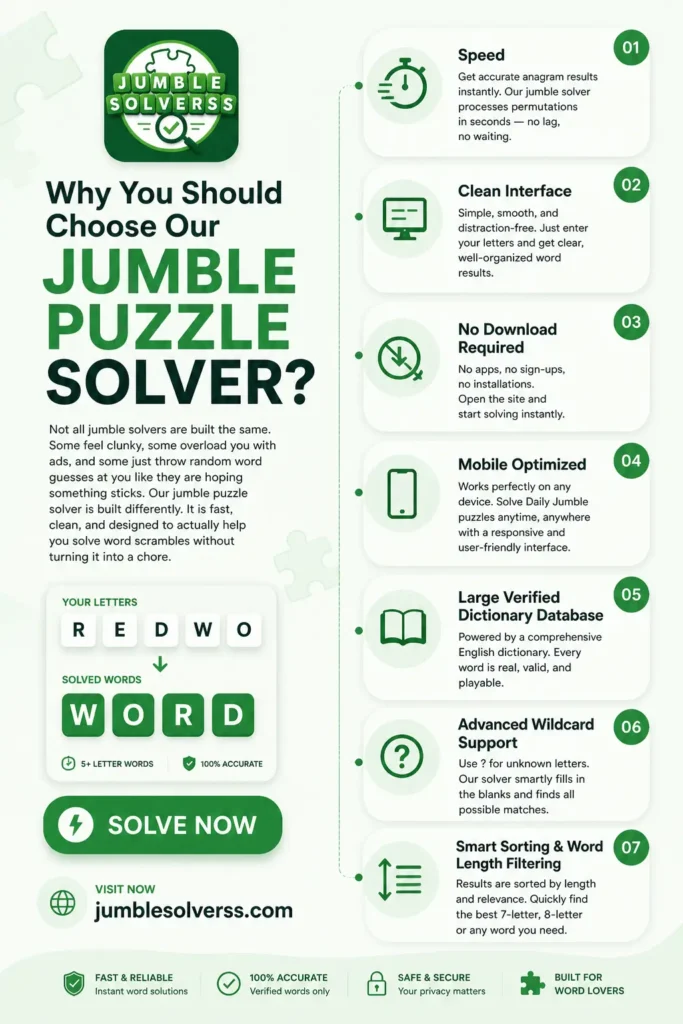
Not all jumble solvers are built the same. Some feel clunky, some overload you with ads, and some just throw random word guesses at you like they are hoping something sticks. Our jumble puzzle solver is built differently. It is fast, clean, and designed to actually help you solve word scrambles without turning it into a chore.
Speed
First things first, speed matters. When you enter scrambled letters, you do not want to wait around like you are buffering a slow video. Our jumble solver processes permutations instantly and delivers accurate word matches in seconds. No lag, no spinning wheels, just quick anagram results so you can move on with your puzzle and keep the momentum going.
Clean Interface
Secondly, the interface is smooth and distraction-free. No cluttered buttons, no confusing filters, and no walls of messy text. Just a simple search box, clear results sorted by length, and easy-to-read word options. Whether you are using it as a word scramble solver, an anagram finder, or a quick jumble cheat, everything feels intuitive and easy to navigate.
No Download Required
You do not need to install anything or create an account for our jumble solver. No extensions, no apps, no weird permissions. Just open the site, enter your letters, and start solving instantly. It works straight from your browser like a lightweight word engine ready to fire up whenever you need it.
Mobile Optimized
And yes, it works perfectly on your phone. Whether you are solving a Daily Jumble on your morning commute or playing a word game during a break, the layout adjusts smoothly to mobile screens. Tap, type, solve, done. Your jumble helper stays pocket-friendly and responsive.
Large Verified Dictionary Database
Our jumble solver is powered by a comprehensive English dictionary database similar to those used in competitive word games. That means the results are not random guesses. Every word is validated and playable, whether you are solving Daily Jumble, Scrabble-style boards, or crossword clues.
Advanced Wildcard Support
You can enter wildcard characters like ? to represent unknown letters, and the jumble solver intelligently substitutes every possible alphabet variation behind the scenes. Instead of giving up when one tile is missing, the system expands possibilities algorithmically and still returns accurate matches.
Smart Sorting & Word Length Filtering
Results are structured intelligently, not dumped in chaos. Words are sorted by length and relevance so you can quickly identify high-impact options like 7-letter or 8-letter combinations. This makes it powerful not just as a jumble cheat, but also as a strategic word finder for competitive games.

Why You Should Pick Our Jumble Solver Over Others
Not all jumble solvers operate at the same level. Some simply rearrange letters and dump random results. Others rely on shallow matching without understanding word structure or context. Below is a technical comparison that highlights the real difference.
| Our Jumble Solver | Typical Jumble Solver |
| Advanced permutation + dictionary validation | Basic letter rearrangement |
| Under 1 second | 3–8 seconds |
| Sorted by length & relevance | Unsorted word lists |
| Supports ? and * | Limited or not supported |
| Handles full phrases | Single-word only |
| Suggests based on clues | No prioritization |
| Handles long letter sets | Slows down or breaks |
| Unlimited, no login | Restricted usage |
| Mobile-friendly | Poor mobile experien |
Real Proof of Function
Instead of just claiming speed or accuracy, here is how our jumble solver performs in real word-solving scenarios. These examples show that the system is not generating random guesses. It applies structured permutation logic, dictionary validation, and intelligent filtering to produce meaningful results.
Word Solving Efficiency Comparison
See how our jumble solver performs compared to basic tools in real scenarios
- ✖ Dumps random word combinations
- ✖ No sorting or prioritization
- ✖ Limited or no wildcard support
- ✖ Cannot handle full phrases
- ✖ Slows down on long inputs
- ✖ No context-aware suggestions
- ✖ Forces manual filtering
- ✔ Generates only valid dictionary words
- ✔ Smart sorting by length & relevance
- ✔ Full wildcard support (? and *)
- ✔ Solves multi-word phrases instantly
- ✔ Fast optimized permutation engine
- ✔ Context-aware suggestions
- ✔ Clean, structured output
Jumble Solve Live Statistics
Join Our Jumble Community
Jumble Word Fixer Examples
Sometimes a jumble puzzle is not just one scrambled word. It is layers, hidden clues, and final mystery answers waiting to be uncovered. That is where a proper jumble solver stops being just a helper and starts feeling like a decoding engine. Below are real examples showing how a word scramble solver handles everything from simple rearrangements to full phrase reconstruction.
Unjumbling The Word FIVE
This is a classic layered Daily Jumble format. First, you solve individual scrambled words. Then, you use selected letters to uncover a final hidden word.
Each word is processed through the solver and rearranged into valid words:
Selected letters from these results are combined again to reveal the hidden word:
Now comes the twist. The puzzle asks you to take specific letters from each solved word. When those highlighted letters are entered back into the jumble solver, the final hidden word appears: FIVE.
What happened here is layered decoding. The solver first handled base-word permutation, then processed a second-level combination using selected letters. No random guessing. Just structured logic and dictionary validation doing the heavy lifting.
Unjumbling The Phrase COME FOR A COFFEE
Now let us step into phrase-level reconstruction. Instead of separate words, you are staring at a scrambled sentence:
The scrambled phrase is broken down and each part is solved individually:
The missing slot is identified and all parts are combined into the final phrase:
Jumble Solver Multiple Words
Multi-word scrambles are common in newspaper puzzles and classroom challenges. Instead of solving each word manually like you are rearranging fridge magnets on a door, you can enter them individually or as a full phrase.
The solver quickly reorganizes the scrambled words into a clear phrase by filtering out invalid combinations and keeping only meaningful results.
Jumble Decoder 2 Words
Two-word scrambles can look simple but become tricky under pressure.
The jumble solver reconstructs APPLE PIE. The answer feels obvious once revealed, but scrambled letters often hide patterns in plain sight.
Jumble Unjumbler 3 Words
Three-word puzzles increase complexity because permutations multiply fast.
The solver restores CAT IS FUN. It evaluates all possible letter combinations and keeps only meaningful word patterns.
Jumble Help 4 Words
Four-word scrambles can feel overwhelming if you try to reshuffle manually.
After processing through the word solver, the result becomes MIND YOUR MANNERS PLEASE. That is structured decoding at work, not luck.
Jumble 5 Letter Solver
Five-letter puzzles are common in Daily Jumble formats.
Valid outputs include EVIL, LIVE, VEIL, and VILE. The solver discards invalid combinations and organizes results clearly so you can choose the correct one for your puzzle.
Word Unscrambler 6 Letters
With six letters, possible arrangements increase dramatically.
The solver returns TEACHER and CHEATER. Same letters, different arrangement, both valid words. Context determines the correct choice.
Word Fixer 8 Letters
Eight-letter scrambles feel intimidating because the permutation count expands rapidly.
The solver reconstructs MENACING. That is algorithmic permutation logic sorting through possibilities at speed.
25 Letter Word Unscrambler
Even long phrase-level scrambles can be processed efficiently.
The solver restores THIS IS A TEST OF JUMBLE. What looks chaotic becomes readable once systematic decoding logic is applied.
Solving Daily Newspaper Jumble Puzzles
Daily Jumble puzzles often require solving base words first and then forming a final hidden answer from selected letters. A strong jumble solver supports individual word unscrambling, wildcard substitutions, phrase reconstruction, and layered clue decoding. Instead of feeling mentally tangled, you move step by step. Letters stop fighting you and patterns start revealing themselves naturally.
6 Easy Steps To Use The Jumble Online Solver
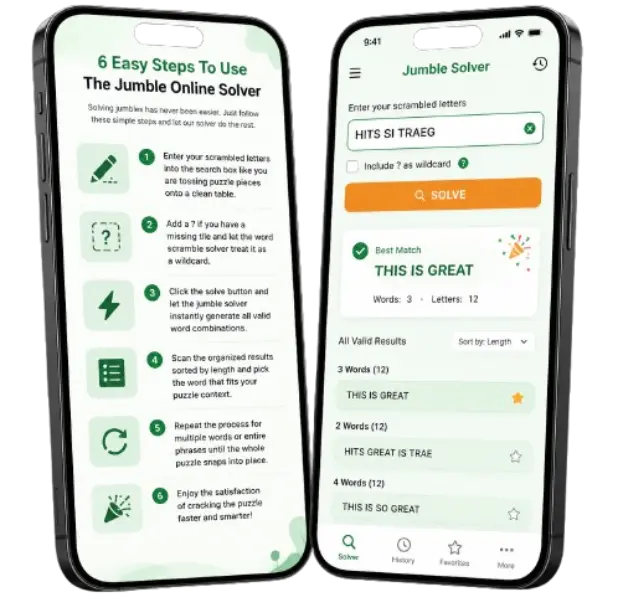
Using this jumble solver unscrambler is honestly as easy as stirring sugar into coffee. No complicated setup, no head-scratching steps, and definitely no “what did I just click” moments. You drop in your scrambled letters, and the word engine does the heavy lifting while you sit back and watch the magic happen. Here are the 6 simple steps you need to follow in order to use our jumble cheat solver:
Use Wildcards in Jumble Word Solver
Sometimes a puzzle throws you a curveball. One letter is missing. One tile is unknown. And suddenly the whole scramble feels like a locked door with no key. That is exactly where wildcard logic steps in. Using wildcards in a jumble word solver is like giving the engine permission to think beyond the obvious and explore every possible alphabet path.
What “?” Does
The question mark symbol works as a flexible stand-in for any missing letter. When you type a ? into the jumble solver, it tells the system to temporarily substitute every letter from A to Z in that position and test all possible combinations against the dictionary database. Instead of guessing what the unknown letter might be, the word scramble solver does the trial-and-error at lightning speed and returns only valid matches.
It is basically a wildcard passport that lets your scrambled word travel through every possible letter variation until it finds real, playable results.
When to Use Blank Letters
Blank letters are useful when you know most of the scramble but one tile is unclear, damaged, or completely missing. Maybe a crossword clue only gives partial information. Maybe a Daily Jumble clue hides one letter. Maybe you misread a tile and are not sure what it was.
That is the moment to plug in a ? and let the jumble decoder fill in the gap. Instead of freezing up and overthinking it, you give the solver room to explore possibilities while you focus on pattern recognition.
Example with Wildcard
Imagine you are working with the letters: TE?CH. You are confident about T, E, C, and H, but the middle letter is uncertain. Enter TE?CH into the jumble solver:
The system now tests TEACH, TENCH, TEECH, and every other logical variation. From the results, TEACH clearly stands out as the meaningful word.
What would have taken minutes of mental reshuffling happens instantly. That is wildcard handling in action. It turns incomplete information into structured answers without the mental gymnastics.
So whenever a letter feels slippery or unknown, do not panic. Drop in a ?, let the jumble word solver stretch its algorithmic muscles, and watch those scrambled mysteries start making sense.
Jumble Solver vs Anagram Solver: What’s the Difference?
At first glance, a jumble solver and an anagram solver look like twins wearing the same hoodie. Both rearrange letters. Both spit out words. But once you look under the hood, the purpose and behavior start to shift.
A jumble solver is usually built for puzzle-style decoding like Daily Jumble and word scramble games, while an anagram solver leans more toward open-ended word discovery and vocabulary exploration. One is a precision tool for solving structured puzzles, the other is more like a creative word generator. They overlap, but they are not identical.
| Feature | Jumble Solver | Anagram Solver |
| Primary Purpose | Designed for solving Daily Jumble and word scramble puzzles | Designed for generating all possible anagrams from given letters |
| Puzzle Context | Often used for structured newspaper puzzles with layered clues | Commonly used for wordplay, creative naming, or vocabulary expansion |
| Wildcard Handling | Optimized for blank tiles like “?” in puzzle scenarios | Supports wildcards but often focused on broad combinations |
| Output Structure | Results usually sorted by word length and puzzle relevance | Often lists every valid permutation without puzzle filtering |
| Multi-Word Support | Handles phrase-level scrambles and layered final answers | Typically focused on single-word rearrangements |
| Use Case | Ideal as a jumble cheat for stuck puzzle moments | Ideal for brainstorming, Scrabble prep, and creative word building |
What is Daily Jumble?
Daily Jumble is that classic scrambled word game that has been twisting brains in the best way since 1954. Originally created under the name “Scramble,” it grew into one of the most popular word puzzles in newspapers across the United States and beyond.
The format is simple but addictive. You get a few mixed-up words, usually with clues, and your job is to unscramble them. Then comes the real twist. Certain letters from those solved words are used to form a final hidden answer, often tied to a cartoon punchline. It is structured chaos that somehow feels satisfying every single time.
What makes Daily Jumble special is the way it trains your pattern recognition without you even noticing. You are basically solving anagrams, but instead of starting with a known word, you start with total disorder and rebuild meaning from scratch. Some days it clicks instantly. Other days it feels like the vowels are hiding from you. That push and pull is what keeps millions hooked. It is not just a puzzle. It is a daily mental workout disguised as fun.
How Is Jumble Played?
Solve Words
Unscramble each word using the solver instantly.
Pick Letters
Selected letters are extracted from solved words.
Build Answer
Letters combine to reveal the final phrase.
Jumble is not just about fixing scrambled letters. It is a layered word puzzle that mixes clues, cartoons, and clever wordplay into one smooth challenge. You are given a short clue along with a drawing that hints at the punchline. Beneath that, you will see four scrambled words, usually two five-letter words and two six-letter words.
Your first mission is to unscramble each one correctly. Once you solve them, certain letters from those answers are marked. Those marked letters are then rearranged again to reveal the final answer phrase, which is often a pun, joke, or playful twist tied to the clue.Here is a clean example so you can see how it flows:
Now imagine certain letters from those solved words are circled. When you gather those marked letters and unscramble them, they form the final phrase:
Water The Plant
That final step is what makes Jumble addictive. You are not just solving separate anagrams. You are building toward a hidden punchline. The clue and cartoon guide you, the scrambled words test your pattern recognition, and the final phrase rewards your decoding skills. It is structured chaos that turns into clarity one step at a time.
Difference Between Jumble, Scramble & Anagram
At first glance, jumble, scramble, and anagram look like three words wearing the same outfit. They all involve mixed-up letters and rearranging them into something meaningful. But once you zoom in, the mechanics and purpose shift slightly.
A jumble usually refers to a structured puzzle format like Daily Jumble with clues and a final hidden phrase.Whereas a scramble is a broader term for any mixed-up letters that need rearranging. Lastly, anagram, on the other hand, starts with a real word or phrase and intentionally rearranges it to form another valid word. Same alphabet playground, different rulebooks.
Word Scramble
The general mixed-letter experience.
|
Ad-Free Experience |
|
|
Clue-Based Solving |
|
|
Final Hidden Phrase |
|
|
Multiple Words Support |
|
|
Quick Rearrangement |
|
|
Single Word Focus |
|
|
Beginner Friendly |
Recommended
Jumble Puzzle
The structured, full puzzle-solving experience.
|
Ad-Free Experience |
|
|
Clue-Based Solving |
|
|
Final Hidden Phrase |
|
|
Multiple Words Support |
|
|
Logical Step Flow |
|
|
Quick Rearrangement |
|
|
Single Word Focus |
Anagram
The creative word rearrangement experience.
|
Ad-Free Experience |
|
|
Unlimited Skips |
|
|
Final Hidden Phrase |
|
|
Multiple Words Support |
|
|
Logical Step Flow |
|
|
Quick Rearrangement |
|
|
Single Word Focus |
Why Do People Get Stuck In Jumble?
Getting stuck in Jumble is not about being “bad at words.” It usually comes down to how the brain processes patterns under pressure. Scrambled letters disrupt normal language recognition, and a few technical bottlenecks kick in.
Functional Fixedness
Once your brain locks onto a wrong letter pattern, it keeps forcing that arrangement instead of exploring new ones. This cognitive bias creates tunnel vision and blocks alternative combinations.
Letter Frequency Disruption
Your brain relies on common English clusters like TH, ER, or ING. When those patterns are distorted or vowels are poorly placed, recognition slows because expected frequency cues are missing.
Working Memory Limits
Six or more letters create dozens or even hundreds of permutations. Your working memory can only juggle a few combinations at once, so manual reshuffling quickly overloads mental capacity.
Lack of Context
Without a clue guiding meaning, the brain operates in pure permutation mode. Language processing works faster with semantic context, so isolated scrambles feel heavier to decode.
Pattern Recognition Fatigue
Even puzzle creators use a jumble solver to verify answers and test difficulty levels. It helps ensure that scrambled words actually have valid solutions and no hidden surprises.
In short, Jumble blocks happen because of cognitive limits, not intelligence gaps. That is why structured decoding tools feel effortless. They bypass human bias, memory limits, and fatigue entirely.
How to Solve Jumble?
Solving Jumble is not about wildly rearranging letters and hoping something sticks. It works best when you follow a clean decoding sequence. Once you treat it like a structured system instead of a guessing game, scrambled letters stop feeling intimidating.
Analyse Available Clues
Start with the blank spaces. You are looking for a 4-letter word followed by a 6-letter word. That alone narrows the search. Now you are not trying every possible permutation, you are solving for specific lengths.
Use Jumble Solver
Enter REACTHSLEN into the jumble solver. First filter for 4-letter words. You might see:
The solver instantly handles permutation logic and dictionary validation, saving you from mentally cycling through hundreds of combinations.
Narrow Your Options
Now apply context from the clue. Suppose the clue hints at medical recovery. That makes HEAL a strong candidate. If the second half suggests a schedule or plan, CHARTS might fit best.
Solve The Puzzle
Once you align both words with the clue, the final answer becomes:
When you approach Jumble like this, it becomes structured decoding instead of alphabet chaos. And if you want to move even faster, the advanced tips below will sharpen your pattern recognition and make these steps feel automatic.
10 Tested Tips To Help You Win Jumble Everytime
Winning at Jumble is not luck. It is pattern recognition, letter positioning, and smart elimination working together like a tight system. The more you understand how scrambled letters behave, the less intimidating they look. Here are battle-tested, practical techniques that actually improve your decoding speed:
1
Understand Prefixes & Suffixes
Scan for common prefixes like RE, PRE, DIS, NON and suffixes like ING, ED, LY, TION. If you spot ING sitting at the end, half the puzzle is already solved. Recognizing structural word endings instantly narrows permutations.
2
Learn Common Letter Combinations
Certain letter pairs love each other in English. TH, CH, SH, BR, ST, PH, CK, and QU almost always appear together. Double consonants like LL or SS are strong visual anchors. Spot the pair, and the word starts forming itself.
3
Separate Vowels from Consonants
Move vowels mentally away from consonant clusters. English words rarely function without vowel support. Repositioning vowels often unlocks structure faster than random shuffling.
4
Count the Letter Length First
Before guessing, check the word length required. A 4-letter solution behaves very differently from a 6-letter one. Length constraints dramatically reduce possible combinations.
5
Analyze the Clue Carefully
In Daily Jumble, the clue is not decoration. It is context scaffolding. Look at the blank spaces and the sentence structure. The clue narrows semantic possibilities before you even touch the letters.
6
Build from Short Words
Start by forming small 2- or 3-letter words like AS, IN, ON, TO. Then extend them. AS becomes ASH. IN becomes RING. Small anchors grow into full solutions.
7
Focus on the First Letter
Try locking one letter in the starting position and rotate the rest around it. This reduces cognitive overload and forces systematic exploration instead of chaotic reshuffling.
8
Use a Paper Sheet
Writing letters down activates spatial memory. When you physically rearrange letters on paper, your brain processes patterns differently. It reduces working memory strain and improves permutation visualization.
9
Narrow Down Options Logically
If your solver shows multiple valid outputs, match them against the sentence context. For example, between EAGLES and BAGELS, the clue determines which one makes sense. Context beats raw combinations.
10
Use Our Jumble Solver Strategically
When cognitive fatigue kicks in or permutations explode beyond manual control, use our jumble solver. It generates all valid combinations grouped by length, filters nonsense, and lets you focus on selecting the correct fit. It is not about cheating. It is about efficiency and pattern reinforcement.
Master these techniques and Jumble stops feeling random. You start seeing structure where others see chaos. Over time, your pattern recognition accelerates, your vocabulary recall sharpens, and scrambled letters lose their intimidation factor completely.
How to Unjumble Words Manually
Sometimes you want to solve the scramble the old-school way and flex your pattern skills. Manual unjumbling is not random shuffling. It is controlled letter rotation with structure and logic.
Step-By-Step Logic
Start by counting letters and spotting repeats. Look for obvious endings like -ED, -ER, or -ING. Then rotate one letter into the first position and cycle the rest around it. This keeps you systematic instead of scrambling blindly.
Sorting Vowels First
Pull the vowels out and spread them across the word slots. English words rarely work without balanced vowel placement. Once vowels are spaced correctly, consonants start falling into place more naturally.
Rearranging Consonants
Now work the consonants around the vowel frame. Scan for common pairs like TH, CH, SH, ST, BR, or double letters like LL and SS. These clusters act like anchors in the jumble chaos.
Word Chunking
Instead of reading letter by letter, try spotting chunks like ING, TION, PRE, RE, or even small roots hiding inside the scramble. Chunking reduces cognitive load and helps your brain recognize structure faster than pure permutation guessing.
Manual solving may take longer than using a jumble solver, but it sharpens your pattern recognition and builds real word instincts over time.
How to Solve Jumble With Multiple Words
Single-word scrambles are warm-up rounds. On the contrary, multiple-word jumbles are where the real brain gymnastics begin. When letters stretch across two or three words, the permutation count multiplies fast. The secret is not to wrestle the entire scramble at once. Decode it in layers.
Start by studying the spacing. Word length is your blueprint. If you see _ _ _ _ _ _ _ _ you already know you are solving a 3-letter word followed by a 5-letter word. Structure first. Rearranging second.
You have two smart approaches. Either enter the full scrambled phrase into a jumble solver and filter results by word length, or break each word cluster apart and solve them individually. Both methods work. The key is systematic reduction.
Two Words Example
Three Words Example
Four Words Example
How to Handle Longer Multi-Word Jumbles
When the scramble looks overwhelming, reduce it:
If mental reshuffling stalls, use a word scramble solver with length filters. Let it generate valid combinations grouped by size, then apply context to pick the phrase that fits.
Multi-word Jumble is not about brute force. It is about controlled decoding. Solve one cluster, eliminate noise, and watch the bigger phrase assemble itself like puzzle pieces snapping together
Jumble Prefix % Suffix Cheatsheet
If scrambled letters feel like they are running in circles, prefixes and suffixes are your traffic police. Instead of reshuffling endlessly, you anchor the beginning or the ending first and let the middle fall into place. That small shift turns random permutation into structured decoding. In jumble jargon, this is called “locking the frame.” Once the frame is fixed, the rest of the word stops fighting you.
Below is a power cheat sheet you can mentally scan whenever a word scramble starts acting stubborn.
Common Prefixes (Front Anchors)
These usually sit at the start of a word and instantly shrink your search field.
| Prefix | Meaning | Example Words |
| RE- | again | REPLAY, REWRITE |
| UN- | not | UNLOCK, UNFAIR |
| DIS- | opposite | DISLIKE, DISMISS |
| PRE- | before | PREHEAT, PREVIEW |
| NON- | without | NONSTOP, NONSENSE |
| MIS- | wrongly | MISREAD, MISPLACE |
| SUB- | under | SUBWAY, SUBMIT |
| INTER- | between | INTERACT, INTERNET |
| OVER- | excessive | OVERLOAD, OVERFLOW |
| UNDER- | below | UNDERPAY, UNDERLINE |
If you see letters like R, E, and another consonant floating near each other, test RE- first. It is one of the most common prefixes in English vocabulary.
Common Suffixes (End Locks)
Suffixes stabilize the tail of the word. Once you fix the ending, the rest becomes much easier to rotate.
| Suffix | Meaning | Example Words |
| -ING | ongoing action | RUNNING, MAKING |
| -ED | past tense | PLAYED, MOVED |
| -ER | doer/comparative | TEACHER, FASTER |
| -LY | adverb | QUICKLY, SLOWLY |
| -TION | noun form | ACTION, MOTION |
| -SION | variation of -TION | VISION, DECISION |
| -ABLE | capable of | READABLE, MOVABLE |
| -LESS | without | HOPELESS, CARELESS |
| -NESS | state of being | DARKNESS, KINDNESS |
| -EST | superlative | FASTEST, BIGGEST |
If you see I, N, G together, test -ING immediately. That trio solves more jumbles than you think.
High-Probability Letter Chunks (Micro Anchors)
These are not full prefixes or suffixes, but they behave like mini word magnets.
| Chunk | Example |
| TH | THINK, OTHER |
| CH | CHAIR, SCHOOL |
| SH | SHAPE, FISH |
| BR | BREAK, BROWN |
| ST | START, STOP |
| QU | QUICK, QUIET |
| LL | SMALL, TELL |
| SS | PASS, MISS |
| PH | PHONE, GRAPH |
Spotting these chunks is like finding puzzle corners before filling the middle.
Most Notable Jumble Word Combinations
Some jumbles solve themselves like a clean zipper pull. Others feel like alphabet soup fighting back. Over time, certain word patterns keep showing up and almost become legends in the jumble world. Here are the combinations players remember for the right and wrong reasons.
Famous Jumbles
These are the smooth ones that click instantly.
They work because of common vowel placement and familiar letter pairs like EA and ER. Once you spot the pattern, the word reveals itself naturally.
Infamous Jumbles
These look simple but trick your brain with multiple possibilities.
These are classic anagram traps. The clue usually decides the winner.
Jumble Hall of Fame
These are the proud wins. The kind where the letters line up like dominoes and you solve the scramble before your coffee cools down. When a messy cluster suddenly transforms into a sharp, witty phrase, it feels like cracking a secret code.
Some classic Hall of Fame moments:
These are the victories that boost your confidence and remind you your pattern radar is getting sharper.
Jumble Hall Of Shame
Now for the humbling moments. The ones that make you stare at the letters like they personally offended you. Heavy consonant stacks, awkward vowel placement, or embarrassingly simple answers hiding in plain sight.
A few legendary facepalm moments:
These are frustrating, yes, but they build real decoding muscle. Every “how did I miss that?” moment trains your brain to scan smarter next time. And eventually, those Hall of Shame puzzles start graduating into Hall of Fame wins. Luckily, you can avoid this shame altogether by using our Jumble solver.
Jumble Wordlists & Worksheets Download
If you want to stop relying on luck and actually sharpen your Jumble solver skills, structured practice is the real game-changer. That is why we offer downloadable jumble wordlists and printable worksheets designed to train your pattern recognition, vocabulary depth, and anagram instincts. Instead of endlessly reshuffling letters, you learn how to spot prefixes, suffixes, vowel balance, and high-frequency letter pairs like a pro word decoder.
Our worksheets cover everything from simple 4-letter scrambles to advanced multi-word phrase puzzles. They are perfect for students building spelling strength, teachers creating classroom activities, homeschool practice sessions, or even competitive word game players who want faster solving speed. Think of it as gym training for your brain, where every worksheet strengthens your word-solving reflex.
Ready to level up? Download the jumble wordlists and worksheets now and start practicing smarter, not harder. The more you train with real scramble sets, the easier daily Jumble puzzles become. Grab your sheets, print them out, and turn every messy letter mix into a clean solve.
Where Can You Play Jumble
Want to scramble words without jumping through hoops or chasing links all over the internet? You can play Jumble in newspapers, apps, and random puzzle sites, but honestly, why make it harder than it needs to be?
On our website, you can play the daily Jumble, crack tricky word scrambles, and fire up the jumble solver the second your brain hits a wall. No tab chaos, no digital wild goose chase, just clean gameplay and instant help when the letters start acting stubborn. Ready to dive in and keep your word streak alive without breaking your flow? Play Jumble right here and start solving like a seasoned pro.
The Psychology of Unjumbling Words
Jumble puzzles are not just word games. They are mini stress tests for your brain. When you understand what is happening cognitively, solving becomes smoother and less frustrating.
Pattern Recognition
Your brain naturally looks for familiar chunks instead of random letters. Research in cognitive science shows humans rely on chunking, grouping letters like TH, ING, ER, or common prefixes such as RE- and UN-. Skilled solvers scan for these anchors first instead of shuffling blindly.
Cognitive Overload
Working memory can only handle a limited number of possibilities at once, often around 4 to 7 items. When a scramble has too many permutations, your brain overloads and performance drops. Locking in prefixes, suffixes, or vowel positions reduces mental clutter.
Why We Miss Obvious Words
This happens due to fixation bias. Once your brain settles on one possible arrangement, it struggles to see alternatives. You might stare at LISTEN but stay stuck on SILENT because your mind locked onto it first.
Mild Panic Effect
Even small time pressure triggers stress, which reduces working memory efficiency. When you panic, pattern recognition slows down. The solution often appears the moment you relax and reset your thinking.
Educational Benefits of Word Jumble Games
Word Jumble games are not just casual brain teasers. In fact, they quietly train multiple cognitive systems at once. When played consistently, they strengthen language processing, memory retention, and flexible thinking without feeling like formal study.
Vocabulary Growth
First of all, Jumble puzzles expand vocabulary through active reconstruction. Instead of simply reading a word, you rebuild it from scattered letters. Research in language acquisition shows that this kind of active retrieval improves lexical access, meaning you recall words faster and more accurately over time.
Cognitive Flexibility
Secondly, solving a word scramble forces your brain to shift strategies quickly. If one arrangement fails, you must immediately try another structure. This improves cognitive flexibility, which psychologists define as the ability to switch between mental frameworks efficiently.
Memory Strengthening
At the same time, Jumble puzzles activate working memory and long-term memory together. You temporarily hold letter combinations in mind while scanning your stored vocabulary for matches.
Classroom Usage
Finally, in educational settings, Jumble exercises are often used to reinforce spelling, prefixes, suffixes, and vocabulary retention. Since students must actively decode words rather than passively recognize them, learning becomes more durable.
Altogether, Jumble games blend fun and function, making them a surprisingly powerful tool for cognitive development.
Frequently Asked Questions
Here are some helpful explanations to guide you through common queries.
Using The Jumble Solver
Features
Accuracy
Use Cases
Final Thoughts
At the end of the day, Jumble is about sharpening your word skills, not staring at scrambled letters in frustration. Whether you need help with a single stubborn word or an entire multi-word puzzle, our Jumble solver gives you structured results in seconds. If you want faster solves, cleaner decoding, and zero guesswork, try our solver now and see the difference yourself. Bookmark our website so the next time a scramble slows you down, the solution is already one click away.