Fast Letter Scrambling
Instantly jumble words, sentences, and paragraphs without manually reshuffling letters for hours.
Readable Word Chaos
The algorithm mixes letters intelligently so scrambled words stay fun and solvable instead of becoming keyboard spaghetti.
Perfect For Classrooms
Great for spelling games, ESL exercises, printable worksheets, vocabulary drills, and classroom brain warmups.
Works On Any Device
Use the word scramble generator smoothly on mobile, tablet, laptop, or desktop without layout breaking.
This page scrambles words. Type any word or sentence above and every word comes back with its letters mixed. If you have scrambled letters and need the real word, you want the Jumble Solver instead.
One thing to check before you use the output: short words sometimes come back unchanged. Three letters have only six possible arrangements, so roughly one in six lands back in the original order. Four letters, one in twenty-four. Anything from five letters up is safe.
What Does Jumble These Letters Mean?
To jumble letters means to rearrange them into a mixed-up order. APPLE becomes PELPA. The word comes from the same root as a jumble sale, where items are piled together without order.
The phrase is used in two opposite directions. Someone building a puzzle wants letters scrambled, and that is what this page does. Someone stuck on a puzzle wants letters unscrambled, which is the Jumble Solver. Both tools are on this site. If the output above is not what you needed, the solver is one click away.
Which Scramble Method To Use
Three methods, three different jobs. Picking the wrong one is why some puzzles feel trivial and others feel impossible.
Random Order
The standard puzzle scramble. Every letter can land anywhere, but the shuffle runs once, so most words keep at least one recognisable fragment. This is the setting for spelling worksheets, classroom warm-ups and anything a person will sit down and solve.
Works best on five to seven letter words. Shorter and there are too few arrangements to be interesting. Longer and the number of possible orders outruns what anyone can hold in their head while testing options.
Keep First And Last Letters
This one is not really a puzzle. Locking the outer letters and shuffling the middle produces text most people can still read, which makes it a reading exercise rather than something to solve.
Use it when the effect itself is the point, or with very young readers who need the word to stay recognisable. Do not use it for a spelling test. The word stays legible, so nobody has to reconstruct anything, and the student learns nothing about how it is spelled.
Tihs txet mghit look lkie a mses at frist gclane. Yuor brian sitll reads it bceasue the frist and lsat lteetrs hvae not mvoed.
Full Randomisation
The hardest setting, because it removes the cues readers use without noticing.
Two things make a scramble genuinely difficult. The first is vowel position. English readers expect vowels spread through the middle of a word, so pushing them to the front or the end breaks the shape being matched against. The second is consonant pairs. Combinations like TH, CH, SH, ST and QU almost never split in real English words, so readers treat them as single units. Separate them and that shortcut is gone.
Full randomisation does both. Use it for adult puzzles and competitive word games.
Why Some Scrambled Text Stays Readable
You have probably seen the paragraph that claims a Cambridge University research team proved letter order does not matter, as long as the first and last letters stay in place.
There was never a study done at Cambridge University. The email originally circulated without mentioning Cambridge at all; the name was added later, after the Times of London interviewed a Cambridge neuropsychologist for comment.
Matt Davis, a researcher at Cambridge's MRC Cognition and Brain Sciences Unit, traced the original demonstration to Graham Rawlinson, who wrote his PhD thesis on letter randomisation at Nottingham University in 1976. Rawlinson ran sixteen experiments and did find that people could recognise words with jumbled middles. Davis points out the caveats the meme leaves out.
What Actually Decides Wether You Can Read It
Short words survive. Long ones don't
Three or four letters in the middle can move without much trouble. Nine letters cannot.
Nearby swaps are easy, distant ones aren't
Porbelm reads as "problem" instantly. Plorebm doesn't, and it follows exactly the same rule.
No accidental words
In that famous paragraph, not one scramble happens to spell something else. That's lucky, not scientific.
When your words turn into complete alphabet chaos 🧠
instantly jumble letters, create brain teasers, and generate fun puzzle-style scrambles in seconds!
Two Problems Every Scrambler Has
Both of these will bite you if you print a worksheet without checking the output first.
The word comes back unchanged
Short words do not have many possible arrangements. A three-letter word has six, so roughly one in six shuffles hands you back the original spelling. Four letters gives you one in twenty-four.
This is not a bug. A genuinely random shuffle has to include the original order as one of its outcomes, or it would not be random. It just means anything under five letters needs a glance before you use it. Five letters and up, the odds drop far enough to stop worrying.
The scramble spells something else
Shuffle STOP and you can land on POTS, TOPS, OPTS or SPOT. Every one is a real word. Every one is a defensible answer. Your answer key lists one of them.
The same thing happens with SILENT and LISTEN, EAGLES and BAGELS, ANGEL and GLEAN. Add a clue or a category header to your worksheet and the ambiguity disappears.
Less often, a scramble produces something you would rather not hand to a classroom. Read the column before you print it.
What People Use It For
Spelling Practice
Scrambling this week's list turns passive review into active reconstruction. Students rebuild the word rather than recognise it.
ESL Vocabulary
Short, common words with clean vowel placement work best. Save the nine-letter scrambles for later.
Classroom warm-ups
In that famous paragraph, not one scramble happens to spell something else. That's lucky, not scientific.
Reading practice for older adults
Keep-first-and-last scrambles are used in cognitive activity groups and care settings, where the point is engaging with familiar text rather than solving a hard puzzle. Short, common words only.
Party and group games
Names, places, in-jokes. Longer words are fine when people solve together.
Chat and social
Scrambled text for Discord, group chats and captions.
Puzzle verification
Building your own word puzzle? Scramble your entries, then run them through the Jumble Solver to confirm each one has a clean answer before you publish.
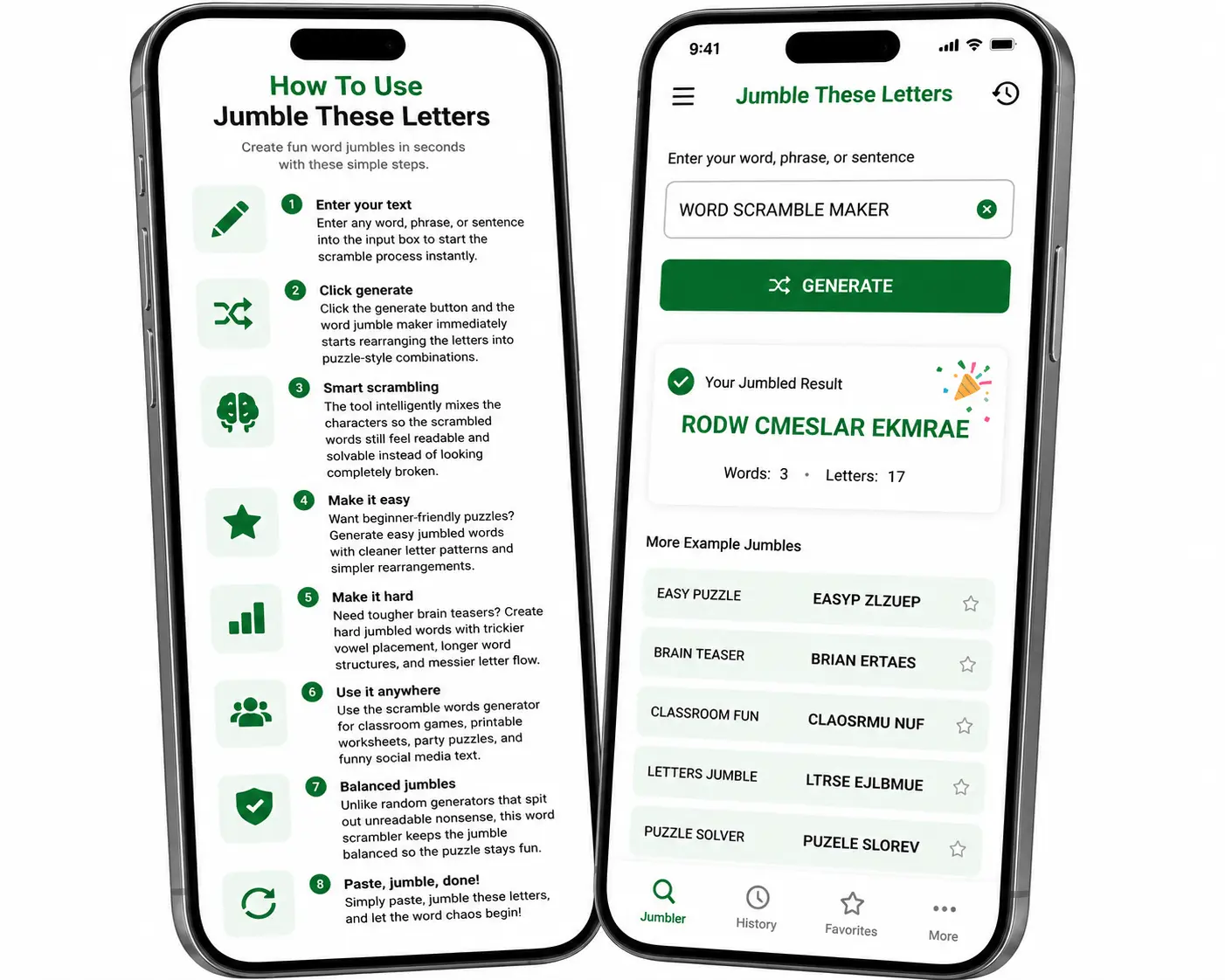
How Our Letter Scrambler Works
Using this Jumble These Letters tool is honestly easier than trying to manually reshuffle the same word twenty times and hoping something finally clicks. Instead of turning your brain into alphabet soup, the tool handles the messy part for you in seconds.
Scrambled Words With Answers
Every pair below has been checked letter by letter. Use them as they are, or as a reference for what good scramble difficulty looks like at each level.
Teachers can quickly generate printable word scrambles for spelling practice, vocabulary revision, ESL learning, brain warmups, and group activities. Meanwhile, students get fun puzzle-style exercises that improve pattern recognition and word decoding without making learning feel painfully boring. Simply enter your words, jumble the letters, print the worksheet, and let the classroom chaos begin in the best way possible.
Easy: Five to Six Letters
| Scrambled | Answer |
| PELPA | APPLE |
| TEWAR | WATER |
| PYHAP | HAPPY |
| NIARB | BRAIN |
| KNIHT | THINK |
| ANREL | LEARN |
| MEHO | HOME |
| IZQU | QUIZ |
| HTAM | MATH |
| NUF | FUN |
Medium: Six to Seven Letters
| Scrambled | Answer |
| NAABAN | BANANA |
| LOOHCS | SCHOOL |
| CILPEN | PENCIL |
| NDFIER | FRIEND |
| ZELPUZ | PUZZLE |
| NERWIN | WINNER |
| ODCEDE | DECODE |
| NORGAD | DRAGON |
| DYUTS | STUDY |
| WELOV | VOWEL |
School Subjects
| Scrambled | Answer |
|---|---|
| DAINGRE | READING |
| TIRWING | WRITING |
| TORSIHY | HISTORY |
| RAPHYGEOG | GEOGRAPHY |
| NECISCE | SCIENCE |
| HSGELIN | ENGLISH |
| SONLES | LESSON |
| CHETARE | TEACHER |
| DENTSTU | STUDENT |
| RALIBRY | LIBRARY |
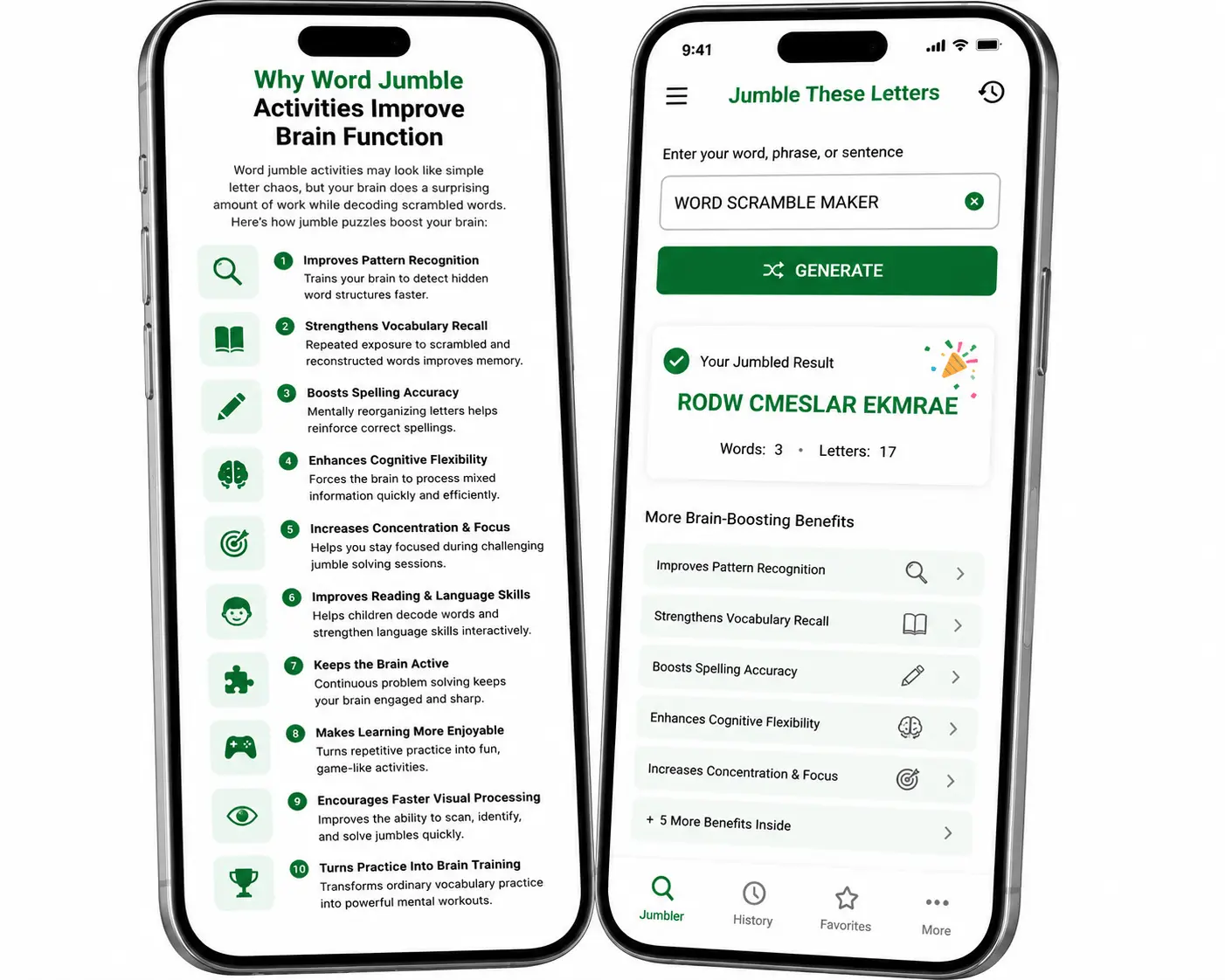
Why Word Jumble Activities Improve Brain Function
Word jumble activities may look like simple letter chaos, but your brain actually does a surprising amount of work while decoding scrambled words. As you solve the jumble these letters puzzle, the brain starts recognizing patterns, scanning vowels, rebuilding word structures, and connecting hidden letter sequences almost automatically.
Therefore, even quick word scramble games can act like mini mental workouts for language processing and memory skills. Nonetheless, here are some reasons why jumble improves neural function:
Word Scrambler vs Word Unscrambler
Although both tools deal with mixed-up letters, they actually do the complete opposite jobs. A word scrambler creates the chaos, while a word unscrambler helps clean up the alphabet soup and solve the puzzle. Therefore, understanding the difference can help you choose the right tool faster depending on whether you want to generate scrambled words or decode them.
| Feature | Word Scrambler | Jumble These Letters Unscrambler |
| Main Purpose | Creates scrambled words | Solves scrambled words |
| User Intent | Generate puzzles | Find answers |
| Common Use | Classroom activities, games, worksheets | Daily Jumble solving, anagram decoding |
| Input | Normal words or sentences | Mixed-up letters |
| Output | Jumbled text | Correct words |
| Difficulty Control | Easy or hard scramble options | Best possible word matches |
| Used By | Teachers, students, puzzle creators | Puzzle solvers, gamers, word nerds |
| Puzzle Style | Creates the alphabet chaos | Fixes the alphabet chaos |
| Supports Worksheets | Yes | Usually no |
| Typical Example | APPLE → LPAEP | LPAEP → APPLE |
| Fun Factor | Making the puzzle | Cracking the puzzle |
| Best Tool For | Word scramble generators | Jumble solvers and word finders |
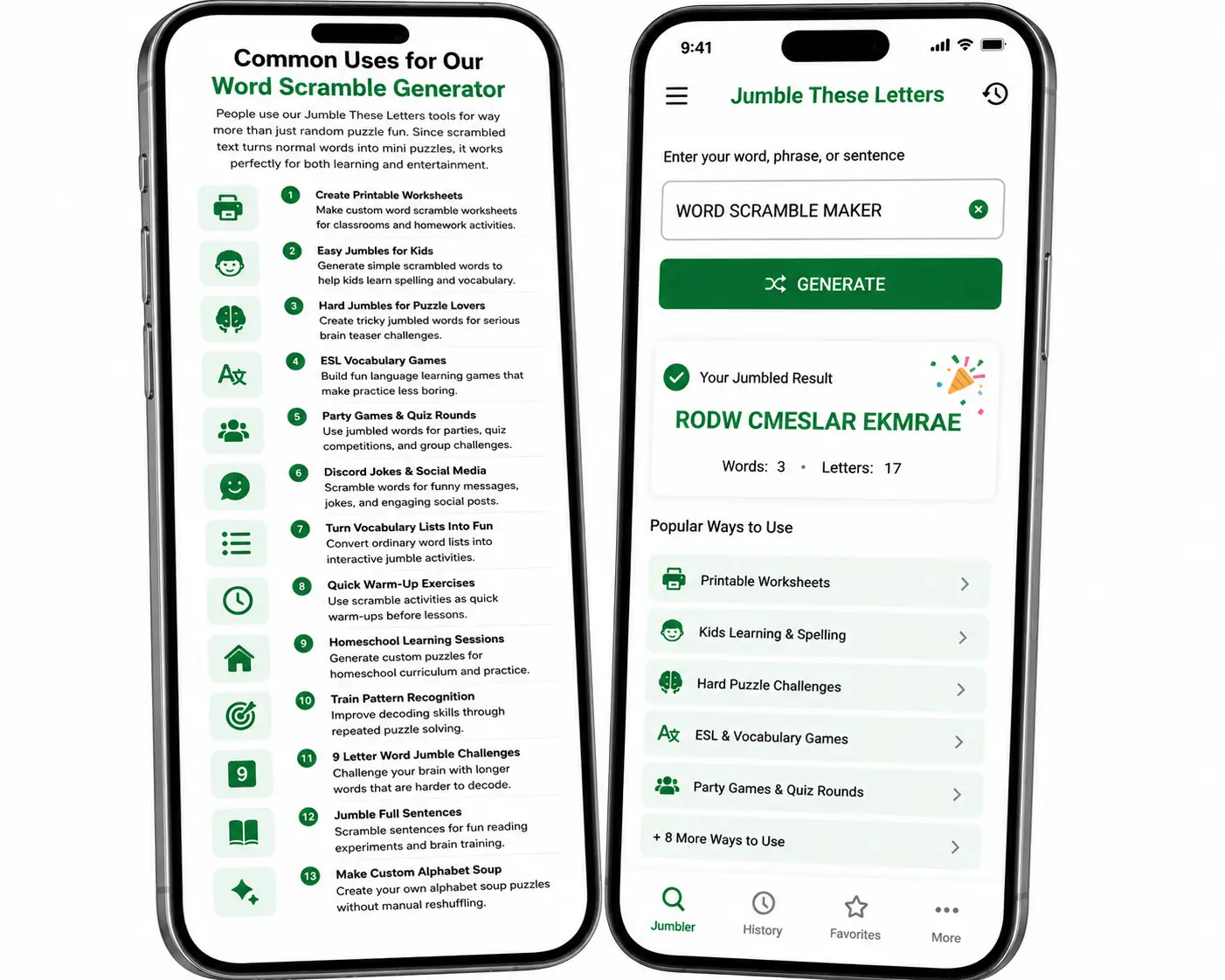
Common Uses for Our Word Scramble Generator
People use our Jumble These Letters tools for way more than just random puzzle fun. Sometimes it is for classroom brain games. Other times it is just friends throwing words into complete alphabet chaos for laughs. Since scrambled text instantly turns normal words into mini puzzles, word jumble generators work surprisingly well for both learning and entertainment.
Frequently Asked Questions
Here are some helpful explanations to guide you through common queries.
Using The Jumble Solver
Features
Accuracy
Use Cases
Final Thoughts
Whether you want to jumble these letters for classroom games, create hard brain-melting scrambles, or just throw words into complete alphabet chaos for fun, a good word scramble generator saves a ton of time and frustration. Instead of manually reshuffling the same letters over and over again like a confused crossword goblin, you can instantly generate clean, readable puzzle-style scrambles in seconds.
Ultimately, this word jumble maker is built to keep things simple, fast, and actually enjoyable to use. From printable word scramble worksheets and ESL vocabulary activities to funny mixed-up text and hardcore jumble challenges, the tool handles everything without turning the output into unreadable keyboard spaghetti. Just paste your text, hit generate, and let the letter chaos begin!